Showing posts with label Lindy Hop. Show all posts

Wednesday, May 29, 2013

Teaching Follows to Swing Dance

Chris and I have had a couple opportunities to teach Balboa and Lindy Hop recently, and we've gotten very gratifying feedback on how well we teach together as a team - especially how much we work with the follows in class. Chris gets as much credit for this as me, because he's very conscientious about making sure the follows have material to work on. I'm just a loudmouth and make sure I get heard in class. :)

Photo courtesy of Dave Welch at Photos With Class
Because of the nice response from our students, I've been thinking lately about our teaching partnership. Of course, we aren't perfect and are always trying to improve on this ourselves, but these are the major points I see as critical in giving the follows an equal education.

1) Stop seeing the follow as the less important member of the team. To teach follows effectively, both the leads and the follows must respect how important their role is in partner dancing. If both teachers model this behavior and outlook, the students will hopefully feel the same way.
Something as simple as the leader-instructor introducing the follows' styling, and showing genuine enthusiasm for spending time on the topic in class, will help balance the roles.

2) Spend enough time preparing - together. The follow-instructor must be clear on the class material in order to participate in actually teaching, not just dancing. I suspect that when the follow-instructor isn't contributing to teaching, it's usually because she doesn't know what the leader-instructor is going to demonstrate next. She's trying to figure it out along with the class.

3) While planning, pay attention to whether the moves are lead-centric or follow-centric. Try to balance the material with different moves or additional styling.

4) Teach the Skills needed when following. This might include where to hold your arms, position your weight, or different footwork that makes a move easier. This is especially important to remember when teaching Advanced classes - teaching the nuances of Following Skills changes an Advanced class from "a bunch of choreography I can never use after I leave class" to "now I'm a better follow!".

5) Sometimes a class will be at a completely different level than the material planned. So go with it! Even though you're teaching off the top of your head, still try to address the reasons why you make certain choices as a follow, not just the mechanics of how to execute the move.

What other techniques do you find helpful for effective teaching of both roles in partner dances? As a student, what do you find helpful, or dislike?

Wednesday, July 18, 2012

Jean Veloz, still dancing at age 88

If you've reading my blog for a while, you might remember me mentioning an original LA lindy hopper named Jean Veloz. She's revered as one of the most stylish and most inspirational swing dancers in LA during the early 40's, and she's still out dancing. A couple weeks ago Jean headed out to Herrang, Sweden, to teach and dance at their yearly event.

Here she is, with all her style and class, dancing with Marcus Koch at Herrang:


We all want to be her when we grow up.

For more on Jean Veloz, click the tag at the bottom.

Wednesday, May 2, 2012

Dancing at Carnation Plaza - Disneyland

Last Saturday we went to Disneyland - this was a bittersweet event because it was the last night of swing dancing at Carnation Plaza. They've had live music and swing dancing there since the late 50's, with top name acts performing like Louis Armstrong, Gene Krupa, Count Basie and Harry James. Oh, yes, and yours truly - I played at Carnation with my high school band. :)

I never really danced at Disneyland - until we moved recently it was just a little too far away to make buying a pass worthwhile - but Chris started dancing there in the late 90's. It was the first place he saw swing dancing in person, and he started taking lessons because dancing at Disneyland looked like fun. How cool is that?! My first swing dance was in a church basement, and his was at DISNEYLAND!

The regular Disney dancers held an "Aloha" party for Carnation 
on the final night, hence the lei.

With good friends Jacob and Emily (and her Minnie Mouse bow!)

Photo by Richard Takenaga

Chris's "Tie my shoe" move. He didn't trip, i swear! ;)
Photo by Teresa Wyman

Photo by Teresa Wyman


And, while we were there I took advantage of having my hair done and 
had my silhouette cut on Main Street.
Passersby got a kick out of watching the silhouette artist work.
Luckily, it only took about a minute. :)

The final product. She made my nose WAY cuter than real life, and I'm okay with that!

Thursday, February 23, 2012

"I'm Just A Jitterbug"

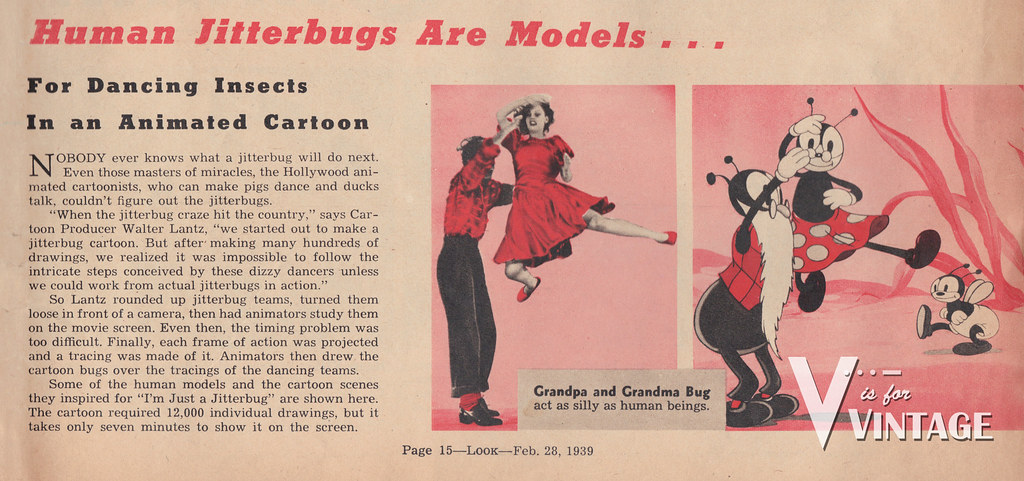
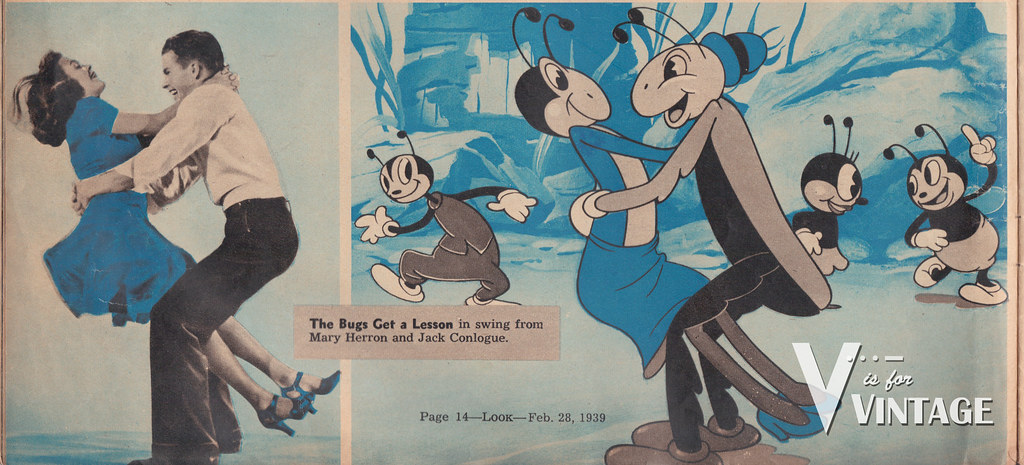
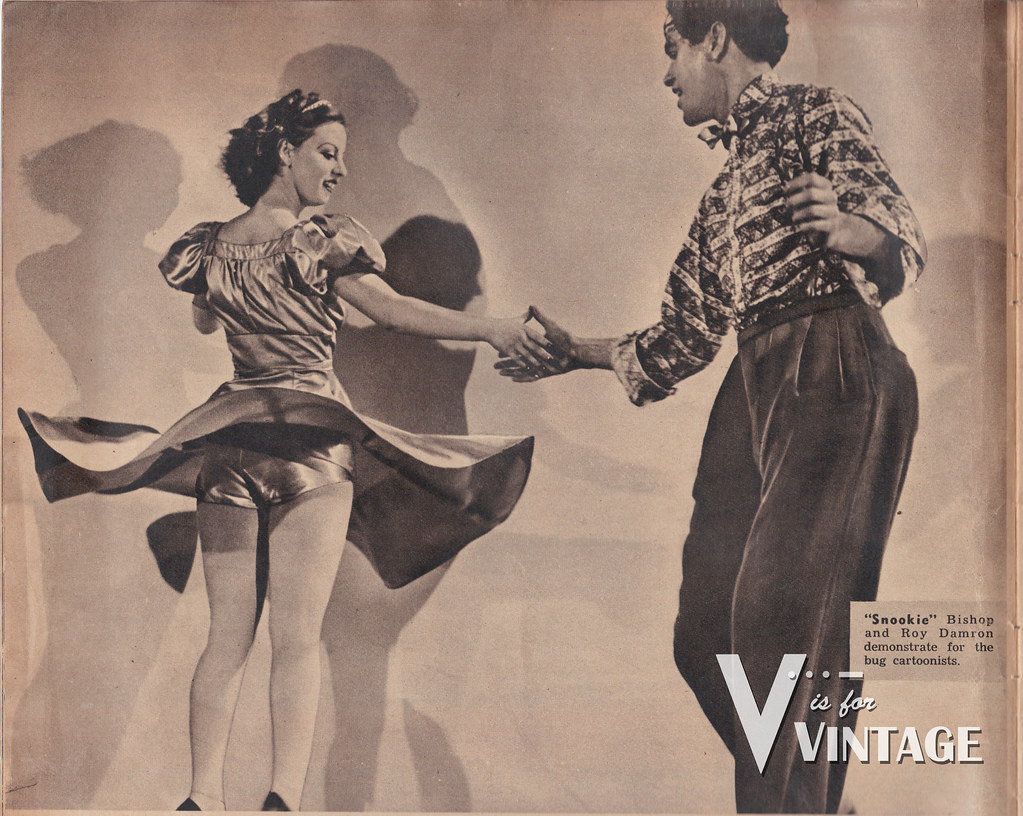
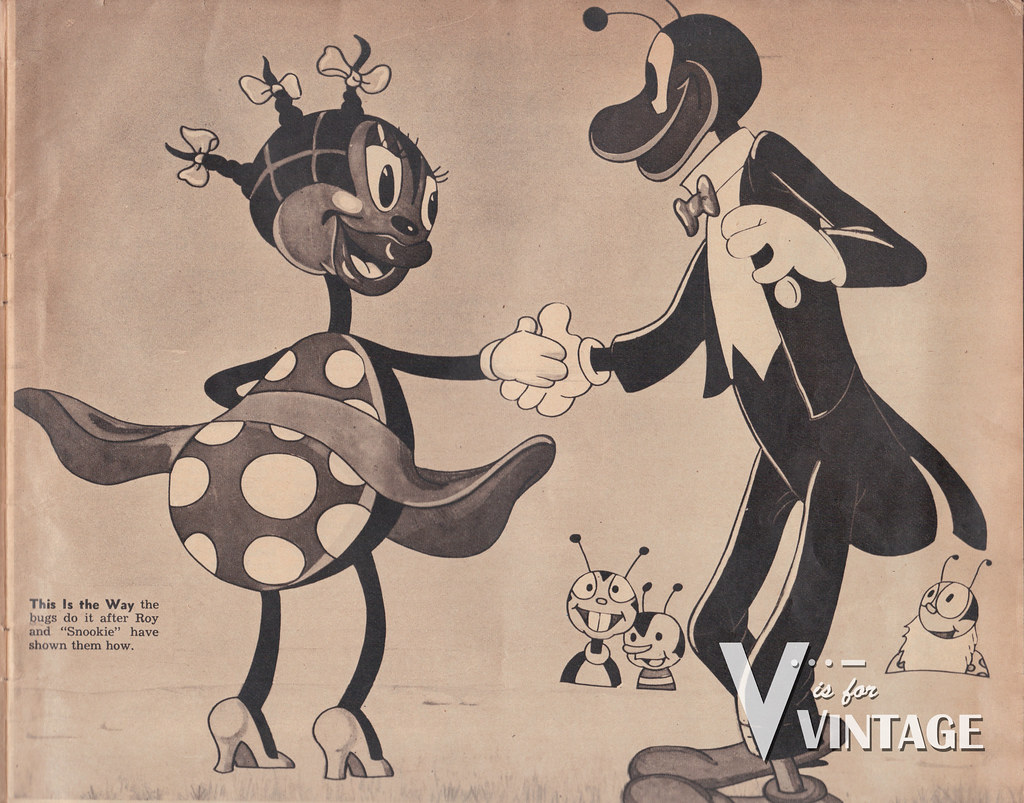
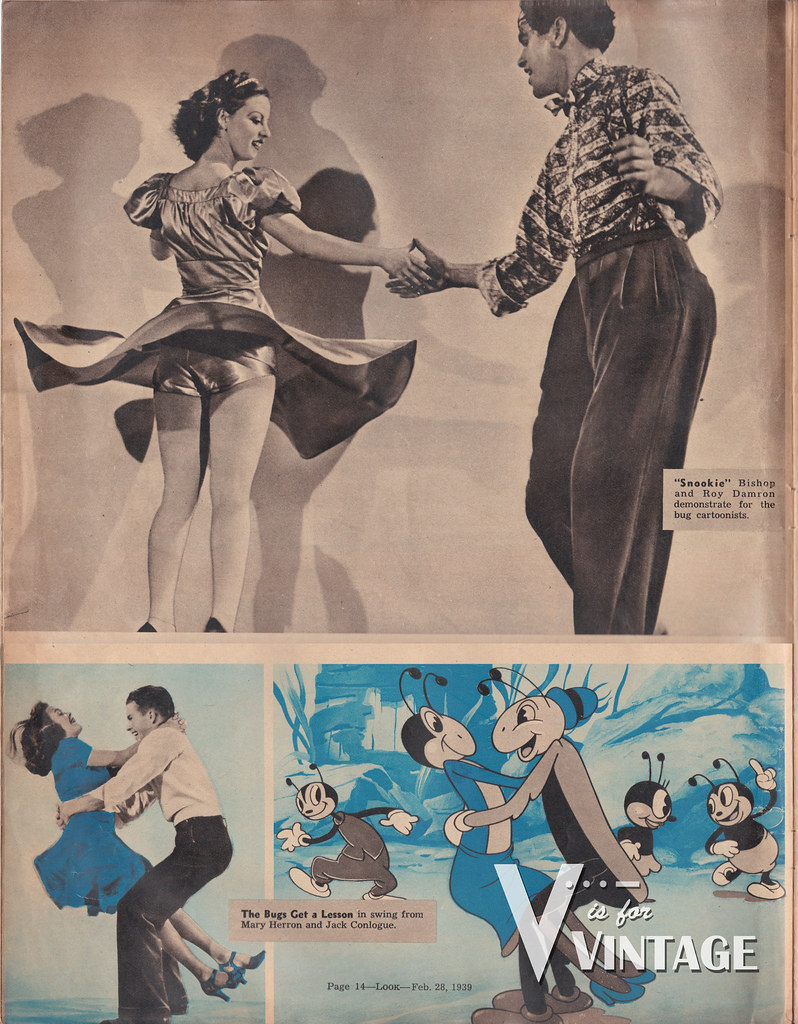
I've fallen off posting about dancing much in the last couple months, but a recent Facebook conversation reminded me that I've been meaning to post this article originally published in a 1939 Look Magazine. It shows some "behind the scenes" shots of LA swing dancers who were filmed as inspiration for the Walter Lantz cartoon short "I'm Just a Jitterbug".

The footage of dancing was rotoscoped for the cartoon (basically traced), which seems to be looked down on by animators, but it's fun for us dancers, because it's so true to life. Only 2 couples are shown in the Look article, but from watching the footage we know that Ray Hirsch and Patti Lacey were part of this project too, because we see their signature moves in it!

As was unfortunately common in this era, there are racist and derogatory images included in the article and cartoon. I have included them in this entry because I feel strongly that it is inappropriate to cut them and not recognize the bigotry present.
----------------------------------------------------------------------------------

Human Jitterbugs Are Models...
For Dancing Insects In an Animated Cartoon

Nobody ever knows what a jitterbug will do next. Even those masters of miracles, the Hollywood animated cartoonists, who cam make pigs dance and ducks talk, couldn't figure out the jitterbugs.

"When the jitterbug craze hit the country," says Cartoon Producer Walter Lantz, "we started out to make a jitterbug cartoon. But after making many hundreds of drawings, we realized it was impossible to follow the intricate steps conceived by these dizzy dancers unless we could work from actual jitterbugs in action."

So Lantz rounded up jitterbug teams, turned them loose in front of a camera, then had animators study them on the movie screen. Even then, the timing problem was too difficult. Finally, each frame of action was projected and a tracing was made of it. Animators then drew the cartoon bugs over the tracings of the dancing teams.

Some of the human models and the cartoon scenes they inspired for "I'm Just a Jitterbug" are shown here. The cartoon required 12,000 individual drawings, but it takes only seven minutes to show it on the screen.

Grandpa and Grandma Bug act as silly as human beings.
(Dancers are Roy Damron and Snookie Bishop)

The Bugs Get a Lesson in swing from Mary Herron and Jack Conlogue.


"Snookie" Bishop and Roy Damron demonstrate for the bug cartoonists.


This is the Way the bugs do it after Roy and "Snookie" have shown them how.

----------------------------------------------------------------------------------


And here's the final version of the cartoon! 
Funny thing is, I don't see any of the images from the magazine in the cartoon.
"I'm Just a Jitterbug" (1939)

Because I like to see the unedited version myself, I've included the complete magazine pages below.


Tuesday, October 4, 2011

Film to Reveal Origin of Jitterbug

I was playing with Google News Reader again, and came across this writeup from The Pittsburgh Press, Dec 23, 1943.


Film to Reveal Origin of Jitterbug
HOLLYWOOD -- Filming of "Jitterbugs," Pete Smith Speciality designed to show how the art of "jitterbugging" developed, will get under way soon, with Will Jason directing.
The short subject boasts a cast of five women and three men, including Arthur Walsh and Jean Phelps, Lennie [sic] and Kay Smith; Charles Saggau and Irene Thomas; and Dorothy Ford and Betty Lou Walker.


Groovie Movie (1944)

----------------------------------------------------
I've never heard of Dorothy Ford & Betty Lou Walker before (I'm guessing Dorothy Ford is this gal?). I wonder what their roles were supposed to be?

Tuesday, September 27, 2011

Arthur Murray: How to Become a Good Dancer

Here are some scans from Arthur Murray's book "How to Become a Good Dancer". Originally published in 1938, Arthur Murray's book illustrates the popular ballroom dance steps using the footprint diagrams he developed for his mail order dance instruction booklets in the 20's.

My edition is from 1942, and the 200+ page book covers general dance technique, Fox Trot, Waltz, Tango, Rumba, La Conga, Samba, and finally, on four piddly little pages at the end, has the Jitterbug and Lindy Hop.

Interestingly, the steps as illustrated are not what you'd learn today in a jitterbug/swing dance class. There are some similarities, but the names of the dances/moves and even where to place beat 1 are different! This is a good reminder that we often view the past through our own experiences, or oversimplify it by thinking that one person's experiences represents everyone. But this way of thinking about "how things used to be" isn't usually accurate. If you danced at the Savoy Ballroom you would have one idea of Lindy Hop, but if you took a class from Arthur Murray you'd have a completely different understanding of the dance - both things you could have done in New York in 1938. Is one right and the other one wrong?


All swing dances used to be called the Jitterbug - 
today we distinguish and separate the various forms much more. 
Here, Shag is called a variation on the Jitterbug.

The photograph referenced in the above instructions.

This version of the Lindy Hop starts on the triple step (our modern beat 3) and 
removes the rotation of the partners. 

This version replaces the triple steps with a tap-step, but it's still an 8-count basic.

"Sugars" are what we call swivels today.

Sunday, May 15, 2011

Roy Damron & Mitzi Mayfair

Do you remember Roy Damron from my post about the Rendezvous Ballroom? I came across a photo of him from The Milwaukee Journal, March 10, 1944. (Google News Archive is my new toy! :) 


Roy Damron with Mitzi Mayfair, one of the stars of Four Jills in a Jeep (1944)

I haven't seen Four Jills in a Jeep in several years (our copy is VHS, and we don't have a player anymore!), but I checked on YouTube and there's a clip of them dancing together! So far as I know, no one has attributed this clip to Roy previously -- it's not on his IMDB profile. Does anyone know how to add it?

Enjoy!


Tuesday, March 29, 2011

Heel, Girl!

Betty Roeser, original (Balboa) Swing dancer,
often wore flats - but her feet flew!
Photo Source: LAPL Library
Over the last week, there's been a lot of chatter in the Lindy Blogosphere about Women Dancing in Heels - Yay or Nay (inspired by Why Women Should Wear Heels by Sarah Breck). I'm not surprised that it created some excitement (although I did think it was going to center around the oppression of women rather than physical comfort! ;) The other night a couple people asked me about dancing in heels, so I thought I'd write up a little sumpthin'.

For roughly the last 3-4 years, I've danced nearly exclusively in heels - not too tall, 2 3/4" is my favorite heel height. But I don't give it a lot of thought, my shoe choice is almost exclusively based on color...

Dancing only in heels wasn't a conscious decision - back before that I only danced in sneakers or wedges, but my feet started feeling heavy and sluggish and grounded, and when I danced in heels it forced me to lighten up and pick up my feet more. It changes your posture because your weight is forced forward onto the ball of your feet, and it gave me a jolt to re-evaluate how I wanted my posture to look while dancing Lindy. The more I wore heels, the more I liked the look and the feeling, and now I feel clunky in wedges. (I still kinda like tennies.)

Nowadays, I rarely drop my heel to the ground, and when I do it's usually to accent a beat or do a certain styling - I almost never put a lot of weight on it. It's come a long way from my old flat-footed dancing!

Reasons I wear heels:
1) I'm lazy - I don't like to change my shoes throughout the night, so I just pick a cute pair and stick with them.
2a) They're loud. I know just enough tap dancing to make trouble, and it's easier to add a little tap rhythm styling while wearing heels.
2b) I'm more inspired to do footwork in general - because I'm not as "grounded" it's easier to move the dogs around.
3) I like the look of a tight narrow base (regardless of 1 foot or 2), and heels help focus your weight into the smallest area possible. Should I try pointe shoes next? :)
4) I only go dancing 1-2 nights per week, and that's when I like to dress up. I'm super casual and wear flats the rest of the time, so I figure I have time to recover from the damage I do to myself. If I danced more, I'd have to switch it up.
5) Heels were popular with Original Balboa dancers.


Reasons to not wear heels:
1) They really do injure you, and make existing joint issues worse.
2) In general, Original Lindy dancers wore flats or wedges.
3) Because your weight is forced only the balls of your feet, it's really really hard to pike properly in a swingout, especially to fast music.

Funny thing is, after talking about wearing heels, I want to get out some flats and experiment with them. I wonder what I'd discover?

Monday, March 21, 2011

Modern Swing Fashion

Back in the late 90s when I started swing dancing, vintage style was all the rage - high-waisted pants, gabardine skirts, the aforementioned long-sleeve blouses...it wasn't enough to dance awesome, you also had to look the part.

Then the popularity of the vintage clothes waned - they're expensive, fragile, and it's hard to make or buy decent repros. Much to the chagrin of club promoters and brides-to-be, jeans and t-shirts were common at even the fanciest events and biggest competitions.

The last couple of years I've seen a real upswing (hehheh - no pun intended) in swing fashions. I chalk this up to 2 causes: among instructors there's a new emphasis on performing choreographed routines, so costuming is being considered more, and the emerging Balboa dance culture prides itself on being Refined instead of Raw. I'm loving it - what you wear has a huge impact on how you move, so dressing the part can actually make you a better dancer!

A couple weeks ago we went to the Saturday night portion of Inspiration Weekend and saw the 30-Second Showcase. This is a competition designed for non-professionals to get their feet wet with choreographing and performing a routine - the dancing was great, but I was really impressed with some of the outfits! So many competitors managed to put together looks that were coordinated without being cheesy, using modern clothes that are dance friendly. I hope to see more of this! :)

All photos used with permission. To see more, please visit BHousePhoto.com
Celina Avila and Jason Le

Morgan Day and Emily Wigger

Michael Seibert and Virginia Zachary

Jack Chen and Brittany Calavitta

 Michael Seibert and Virginia Zachary


Wednesday, March 16, 2011

Swivels: Footwork

Finally getting to the promised footwork part of swivels - better late than never, right? I hope so.

There are two basic footwork patterns that you can do, and they're both easy. They both take 2 beats, so they can be done on the 1+2 of a swingout, or repeated for switches.

Are you ready? for the big Reveal? In no particular order, the two footwork patterns are:
(dum-dum-DA!)

Step-Step: step on alternate feet evenly on every beat (1 2)
Kick-Ball-Change*: kick with your right foot, step on your right foot, step on your left foot (1+2)

These two footwork patterns are interchangeable because they take the same number of beats and you wind up on the same foot at the end. The Kick-Ball-Change is just a gussied up version of the Step-Step.

Let's take a look at these in action - my apologies for repeating clips, but I want to use ones where you can see their feet.

Step-Step Swivels (I call these "Jewel swivels" because this is her standard footwork)
Buck Privates at 1:49 - Jewel just steps on every beat, starting by sitting deep into the 7+8 of the previous swingout. On the even beats (8, 2, 4, 6, etc.) she steps to the left with her left foot, and then brings her right foot to meet it on the odd beats (1, 3, 5, 7), all while maintaining her turnout.

Kick-Ball-Change Swivels (I call these "Jean swivels" -- guess why?)
Groovie Movie at 3:45 - it's hard to see if you aren't looking for it, but Jean is doing KBC swivels. You can tell because her toe comes up slightly on 1, which doesn't happen if you're putting your weight down. It's not a big kick from the knee, it's just a little flick. Try keeping your heel slightly touching the ground.

Groovie Movie at 5:36 - here you can see Irene Thomas (brunette in the center) and Kay Smith doing KBC swivels alongside Jean. It's nice to see some other LA follows featured in switches besides just Jean and Jewel!

The footwork pattern you choose is completely personal choice, and it's not dictated by the lead at all. Use the music as your cue - I think that Step-Step swivels are a little smoother, and KBC swivels are snappier. You can travel cover more distance with Step-Step swivels than KBC, and when the music's really fast you won't have enough time between the beats for Kick-Ball-Changes, so Step-Steps are your only option. Practice both and play with changing them up!
________________________
*Kick-Ball-Change = KICK/step on the BALL of same foot/CHANGE your weight to opposite foot
It's not "Kick the old ball and chain"...

Wednesday, February 9, 2011

Swivels: Practice that Shoulder Stuff

How you hold your shoulders during swivels and switches has a big impact on the overall look - for the classic LA style swivels, it's important to pull your shoulders back and center them over your core (don't hunch forward and don't lean back - your shoulders should be directly over your hips). This technique is functional as well as stylistic - you're building a solid foundation in your midsection, so that your bottom half can relax and let your feet do more than just hold you up.

Go look in a mirror and practice this. Hold onto a doorway and bend your knees a little, and check your posture in that mirror. You don't even need a full length mirror - your bathroom is fine, because you're only looking at your shoulders. If you feel wobbly, try to use your stomach and back muscles a little more. If you can't find those muscles, go do a couple stomach crunches to show you where they are!

Got that posture figured out? Now here's the tricky bit. While doing your footwork*, isolate your shoulders and don't let them rotate forward & back/left & right as your hips move. Hold them steady. Don't let them wiggle and flop around and distract from your nice turnout you've worked on. Pay extra close attention when you rotate to the right - keep that left shoulder in place!

Okay, here's your inspiration clips - you've earned it!
"Chool Song", Dean Collins and Jewel McGowan dancing
In her switches at 1:00, Jewel holds her top half up and steady, and her shoulders barely wiggle - even with those giant sleeves that accentuate everything! Notice too that she opens up from Dean a little - she's not perfectly parallel to him (which makes this a better angle for the audience), but she still holds steady.

"One Girl and Two Boys" from Swing Fever, Jean Veloz dancing with Don Gallagher and Lenny Smith
In this clip, Jean does some sassy ups and downs with her shoulders, but still keeps them back and doesn't let them rock in as she swivels. Notice too how her arm does different stylings, but she still keeps her posture.

If you feel inclined, go back and watch the last clips I posted, and this time watch their shoulders. I'm trying to post a variety of clips (and not just Buck Privates every time!), but if you're into this, go watch them all again!
_________________________
*Footwork- still planning a post on this, but that one will take a little more time to write, so I'm stalling! :)

Saturday, January 29, 2011

Swivels: Don't cheat your turnout

I'm an old school LA style Lindy Hopper, and as such I've spent more time watching old clips of Jewel McGowan and Jean Veloz do swivels than is strictly healthy. Fuzzy black and white images, played in slow motion, over and over and over...retina strain? OCD tendancies? sleepless nights?

In an effort to save you this pain, I thought I'd share some of my observations -- if you're interested in swing dancing, I'm very interested in your feedback. If you're here because of a more general interest in vintage style, please enjoy the clips and come back for future posts on fashion, music, etc!

Watching clips today, I realized that one of the critical elements in achieving sharp swivels is having an equal amount of turnout on both legs. A lot of girls will turn out their left leg on beat 8 of a swingout, but not rotate back in toward their right arm and turn out their right leg on beat 1. If your turnout isn't even, your swivels will have all the snap on only one side and not be smooth and even.

Here's the classic Buck Privates example:
At 1:37, Dean Collins and Jewel McGowan lay into some of the prettiest swingouts ever recorded on video, followed up with the epitome of switches at 1:49. Even if you can't see her feet the whole time, you can see that Jewel's knees rotate an equal amount left to right.

And Groovie Movie:
At 3:45, Jean Veloz (dancing with Arthur Walsh) lays into some deep swivels of her own - even though her footwork is different from Jewel's, she still gets plenty of turnout on both sides. (I'll go over footwork in a future post.)

Of course, there are always exceptions to any rule...Jewel McGowan usually has amazing turnout, but in the Baby Boogie, her switches at :25 aren't even on both sides. Does it look as good as usual? I don't think so - her right side kinda drags along.

Nitpicky? Absolutely. But the main differences between LA style and other forms of Lindy Hop are stylistic  - we do the same moves, but in a different way - so if you aren't precise about your execution, the style gets lost.
Related Posts Plugin for WordPress, Blogger...